Florida Save Our Homes Portability: How Much Property Tax Savings Can You Take With You?

How Much of Your Florida Property Tax Savings Can You Take With You?
If you have owned your Broward County home for many years, your property taxes may be much lower than the taxes a new buyer would pay for the same home.
That difference can be valuable when you move.
Florida calls it Save Our Homes portability, and for homeowners thinking about downsizing, it can make a real difference in what the next home costs to own.
The part that confuses many homeowners is this: you do not simply take your current tax bill with you.
There is a calculation involved.
First, what is Save Our Homes?
Once a Florida home receives the Homestead Exemption, future increases in its assessed value are generally limited to the lower of 3% or the annual change in the Consumer Price Index. Over many years, this can create a large difference between the home's market value and its assessed value. (Florida Dept. of Revenue)
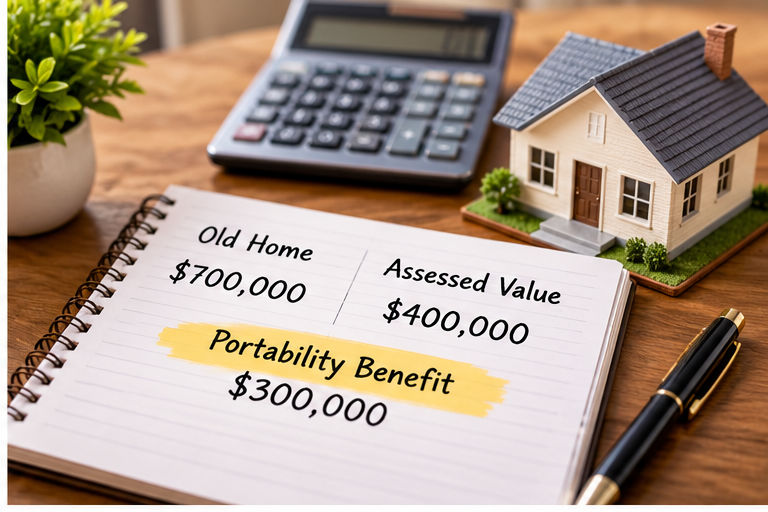
For example, imagine your longtime Broward home has:
Market value: $700,000
Save Our Homes assessed value: $400,000
The difference is $300,000.
That $300,000 is your Save Our Homes assessment difference and may potentially be carried to another Florida homestead through portability.
Florida currently allows an eligible homeowner to transfer as much as $500,000 of Save Our Homes assessment difference to a new Florida homestead. (Florida Dept. of Revenue)
What happens if you buy a more expensive home?
This is the easier example.
If your new homestead has an equal or higher value than your previous homestead, you may generally transfer your full Save Our Homes assessment difference, up to the $500,000 limit. (Broward County Property Appraiser)
Using our example, if you had a $300,000 portability benefit and purchased an $800,000 home, that benefit could potentially reduce the home's assessed value substantially.
That does not mean you receive a $300,000 tax deduction or a $300,000 cash benefit. It means the amount used to calculate your property taxes may be reduced.
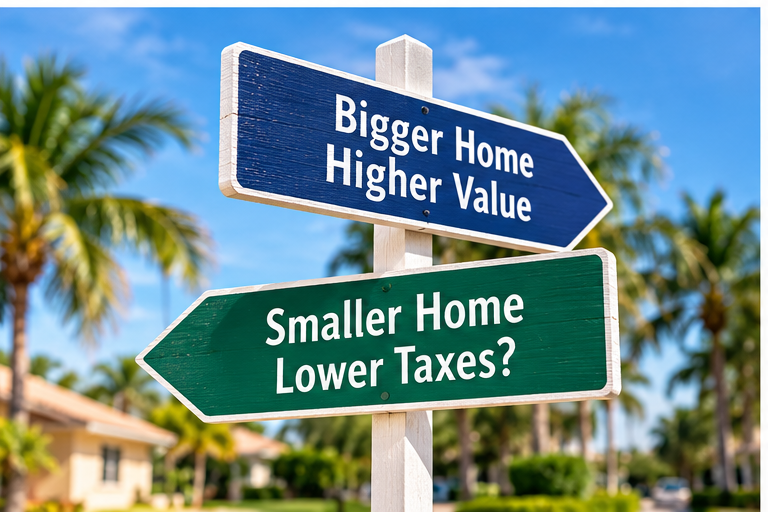
But what if you're downsizing?
This is where many longtime Broward homeowners get surprised.
Let's say you are selling the larger family home and buying something smaller.
When the new home's value is lower than the old home's value, Florida uses a percentage-based calculation instead of automatically moving the entire dollar amount.
In simple terms, Florida looks at the relationship between your old home's assessed value and market value, then applies that relationship to the new property. (Florida Dept. of Revenue)
So if you have $300,000 in accumulated Save Our Homes protection, you should not automatically assume all $300,000 will transfer to a lower-priced home.
You may still receive a very valuable tax benefit, but the amount can be different.
Do you have to stay in Broward County?
No.
Portability is a Florida benefit, not just a Broward County benefit.
You could sell your homesteaded property in Plantation, Coral Springs, Davie, Pompano Beach, or another Broward community and potentially transfer the benefit to another qualifying homestead anywhere in Florida. Broward's Property Appraiser specifically notes that portability may be used for moves anywhere within the state. (Broward County Property Appraiser)
That can be especially important for homeowners moving into a condo, 55+ community, smaller home, or another part of Florida for retirement.
How long do you have to use your portability?
Timing matters.
Florida generally requires you to establish the new homestead within the allowed three-year portability period. More precisely, you must qualify for Homestead Exemption on the new property within the applicable three tax years after abandoning the previous homestead. It is not simply three years from your closing date. (Florida Dept. of Revenue)
You also need to apply for Homestead Exemption on the new property and file the portability application. Florida uses Form DR-501T, and the normal filing deadline is March 1.
Don't confuse portability with Homestead Exemption
This is another common mistake.
Your Homestead Exemption itself does not move from one house to another.
You apply for Homestead Exemption again on your new primary residence. Portability allows you to bring qualifying Save Our Homes assessment savings from the previous property. (Broward County Property Appraiser)
Those are two related, but different, things.

Before you decide what you can afford, check the numbers
We see why this becomes especially important for longtime homeowners.
You may be thinking:
"If I sell my $800,000 house and buy a $500,000 home, my taxes should automatically drop."
Maybe.
But you should not make a buying decision based only on the seller's current property tax bill or a rough estimate.
The new owner's taxes can be very different, and your portability benefit needs to be calculated using your own previous homestead information.
The Broward County Property Appraiser even provides a Portability Estimator, while cautioning that some situations involving ownership percentages, divorce, or shared ownership require additional calculations. (Broward County Property Appraiser)
This is where good planning matters
For longtime homeowners, especially those thinking about downsizing or retirement, property taxes should be part of the conversation before you choose the next home, not after you close.
When we work with homeowners making this type of move, we like to look at the whole picture: what the current home may sell for, what the next home may cost, estimated taxes, portability, insurance, HOA costs, maintenance, and the lifestyle the homeowner wants afterward.
Sometimes the least expensive home on paper isn't necessarily the least expensive home to own.
That kind of planning can make a move much easier to understand.
One important disclaimer
The Chriz Tokar Team and RE/MAX Advance Realty are not attorneys, accountants, tax professionals, or property appraisers. This article is provided for general educational information only and should not be considered legal, accounting, or tax advice.
Florida property tax laws and individual circumstances can be complicated. Before making financial decisions, homeowners should confirm their specific portability amount and Homestead eligibility with the Broward County Property Appraiser or the property appraiser in the county where the new home will be located. For tax or legal questions, speak with a qualified accountant, tax professional, or attorney.
If you're thinking about selling a longtime Broward County home and downsizing, understanding portability is just one part of the plan. Knowing the numbers before you list and before you buy can help you make a much more informed move.
For More Information Contact:
Chriz Tokar & Bruce Field - 954-600-7427
The Chriz Tokar Team
RE/MAX Advance Realty